Yuri Vladimirovich Waltz
Полковник Вальц Юрий Владимирович
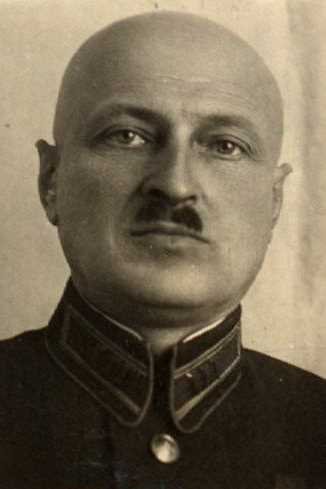
Yuri Vladimirovich Waltz was a career cavalry officer who served three armies: the Tsar's, then the Bolsheviks', then the Red Army at war with Germany. He spent the 1920s and '30s working his way up through cavalry regiments and staff postings, made colonel in 1936, and by the time the Germans invaded was commanding a division. He was killed in 1942 as deputy commander of the 5th Cavalry Corps, fighting a losing defensive battle south of Izium — though the record is honestly a little murky on exactly when.
This page is built from his Soviet Ministry of Defense file, digitized by the Память народа project and cross-checked against ЦАМО loss and personnel records. Full scans, transcriptions, and citations are on Sources & Artifacts.
- Born
- 26 March 1897, Pavlovsk (now Novoukrainka), Kherson Governorate
- Died
- 1942, Southern Front, south of Izium
- Rank
- Colonel (1936)
- Last command
- Deputy commander, 5th Cavalry Corps
- Wife
- Elizaveta Nikolaevna Waltz
- Daughter
- Nina, b. 1926
Early life and the Imperial Army
Waltz was born on 26 March 1897 in Pavlovsk, a settlement later absorbed into and renamed Novoukrainka, in the Elisavetgrad district of Kherson Governorate — territory that's now Kirovohrad Oblast, Ukraine. He finished seven years of gymnasium, and his service record lists him, throughout, as ethnically Russian. In November 1915 the Imperial Army sent him to the 9th Reserve Cavalry Regiment in Petrograd, where he worked up from private to junior non-commissioned officer over two years in the ranks.
Civil War, 1918–1921
He joined the Red Army in March 1918 and spent the Civil War moving fast between commands. He led a machine-gun platoon against White Finnish forces in Karelia that spring, then took a squadron of the 2nd Bashkir Cavalry Regiment into the fighting against General Yudenich's drive on Petrograd in the autumn of 1919. By 1920 he was commanding line troops of the 8th Rifle Division against Polish forces, and was wounded in the head crossing the Berezina during a withdrawal. The rest of that year he ran a horse-collection depot in the North Caucasus — the unglamorous work of finding remounts for a cavalry army running out of horses.
Between the wars
Peacetime sent him back to school: the Higher Cavalry School in Petrograd (1921–23), then staff courses at Odessa, then the Red Army's advanced command courses in 1931–32. In between he held a run of regimental postings — the 9th Crimean and 4th Cavalry Divisions, chief of staff of the 20th Sal'sky Cavalry Regiment, command of the 70th Cavalry Regiment from 1930. From 1934 he moved into training commanders rather than leading them in the field: first the cadet regiment at the Red Banner Cavalry School, then, from 1936, the Tambov Cavalry School, which he ran outright from June 1940. He made colonel in 1936 and joined the Communist Party the following year. The full posting-by-posting record is on the Sources page.
War, 1941–1942
When the Germans invaded, Waltz was commanding the 54th Independent Cavalry Division in the Oryol Military District. By December 1941 he was chief of staff of the 2nd Cavalry Corps on the Western Front, and briefly its acting commander in February 1942, during a raid that took the corps 500 kilometers behind German lines and into the town of Alexandropol — which it captured and then couldn't hold.
In April 1942 he moved to the 5th Cavalry Corps, fighting a losing defensive battle south of Izium on the Southern Front, and was killed during the corps' breakout from encirclement near Voloshino. A fellow officer's account, later quoted in his wife's letters to the Red Army Cavalry Command, has him riding out with a small patrol to check that the withdrawing divisions were holding formation, and never returning — only his orderly's horse came back. A second, secondhand account puts him shot from the saddle near Kamenskaya station around the same time. Neither witness saw the moment itself, and the paperwork itself is split on the date: the roll-removal order has him dead in April 1942, while a certificate from his own former corps commander, General Parkhomenko, puts it three months later, the night of 16–17 July. A 1948 Finance Directorate memo, chasing down his family's pension, flags the contradiction and asks someone to settle it; nothing in the file shows that anyone ever did. Both accounts and the full paper trail are on Sources & Artifacts.
He held the Order of the Red Star, awarded 22 February 1941, and the "XX Years of the Red Army" jubilee medal. He'd been wounded once before this — on the Polish front, twenty-two years earlier.
Family
His own personnel card says only that he was married — no name. Three separate 1943 records supply one: a pension certificate, a Chkalov военкомат roll-removal register, and a June 1943 loss report all name his wife as Elizaveta Nikolaevna Waltz. The loss report goes further, naming their daughter, Nina, born 1926, living with her mother at the same address — the earliest documented link tying Nina Waltz to this family.
| Relation | Name | Detail |
|---|---|---|
| Self | Yuri Vladimirovich Waltz | b. 26 Mar 1897, Pavlovsk/Novoukrainka — d. 1942, Southern Front |
| Wife | Elizaveta Nikolaevna Waltz | Named in three 1943 ЦАМО documents; her letters describe his death |
| Daughter | Nina Waltz | b. 1926; living with her mother in Chkalov as of June 1943 |
Their address in 1943 was г. Чкалов, Авиагородок, дом № 2/27, кв. 33 — Chkalov (renamed Orenburg in 1957), in the Aviagorodok military-aviation housing district, confirmed independently in two separate documents.
Where he came from — an open question
Nothing in the file names his parents. His patronymic puts his father's name as Vladimir and nothing more. The one outside source that adds anything — a biographical note from the Tambov regional library, tied to his years running the Tambov Cavalry School — describes him as born "into a family of white-collar employees of German origin," without naming them either. That's consistent either with ethnic-German colonist stock (the Elisavetgrad district held several German Lutheran and Catholic colonies) or with a Germanic surname several generations into assimilation; his own paperwork lists him as ethnically Russian throughout, which — for a Party member with a German surname in the 1930s — tells you more about the times than about his ancestry. Despite the shared surname, there's no link to the one well-documented Waltz family in Russian records, the Bolshoi Theatre's Karl Fyodorovich Waltz and his father Fyodor — different patronymic line, different city, no connection on paper. The most promising lead is his actual personal file (ЦАМО box В-103), which Память народа hasn't digitized; reaching it means a formal archive request. Sources and the full reasoning are on the Sources page.
A second Память народа entry, for a Colonel Yuri Vladimirovich Waltz tied to the Northwestern Front, doesn't match this man's documented service and is most likely a different officer who happened to share the name — see Sources for the comparison.
Timeline
- 1897Born in Pavlovsk, Kherson Governorate.
- 1915–18Imperial Army, 9th Reserve Cavalry Regiment.
- 1918Joins the Red Army; fights in Karelia.
- 1919Squadron command against Yudenich, near Petrograd.
- 1920Wounded at the Berezina, fighting Polish forces.
- 1921–23Higher Cavalry School, Petrograd.
- 1923–34A run of cavalry regimental postings, Crimea to the Caucasus.
- 1936Promoted colonel; heads the Tambov Cavalry School from 1940.
- 1941Commands the 54th Cavalry Division at the war's outbreak.
- Feb 1942Acting commander, 2nd Cavalry Corps, during the raid on Alexandropol.
- 1942Deputy commander, 5th Cavalry Corps, Southern Front — killed during the corps' breakout near Voloshino.
- 1943His wife and daughter, in Chkalov, are documented for the first time, fighting for his pension.
- 1948The Army is still arguing over his date of death.